Construction doesn’t have a problem with the number of workers. It has a problem defining what the new worker should be.
Israel experienced this sharply. Overnight, the industry lost tens of thousands of workers and many job sites shut down. The government’s response was to issue 61,000 new work permits from ten countries. Construction input costs rose 5.1% in a single year, driven primarily by labor. That was crisis management, not a solution.
The real problem is structural. Construction, as it presents itself to the outside world, doesn’t attract enough of the kind of people who could innovate and sustain it over the coming decades. In the US alone, the industry needs 499,000 additional workers in 2026, and 92% of hiring firms say qualified candidates are hard to find. This isn’t an Israeli problem. It’s the problem of an entire industry still telling the same story it told a hundred years ago.
Young people looking for a career aren’t just looking for a salary. According to Deloitte research from 2025, lack of career advancement is the second most common reason young people leave jobs, after pay. They’re looking for where they’re going, and they want to find that through work that feels familiar. They grew up with technology in their hands: a workplace with machines, data, and screens feels more natural to them than a classical job site.
Something is shifting. In 2019, Gen Z made up 6.4% of construction workers in the US. By 2023, that number reached 14.1%. Nearly doubled in four years. The reason is simple: 91% of them prefer employers who use advanced technology. When job sites started looking different, some younger people changed their minds.
And here robotics enters the picture. Not only 3D concrete printing. Fastbrick’s Hadrian X bricklaying robot built entire homes in under three days. Advanced Construction Robotics’ TyBOT and IronBOT tie rebar in bridges with efficiency that cuts time by 50%. Built Robotics turned standard excavation equipment into fully autonomous machines using sensors and AI. In each of these cases, a worker didn’t disappear. A new role was created.
I made this move myself. I went from developing websites to developing construction sites. What drew me there wasn’t just the change. It was a feeling that the two were about to converge. That an industry built on hands and personal experience was becoming one built on data, machines, and people who understand both. There’s a name for it: Construction 4.0. The integration of BIM, robotics, 3D concrete printing, and AI that turns an unpredictable process into a precise one, and physical labor into engineering responsibility.
What I found along the way confirmed the feeling. Construction and development are more similar than they appear. Both are built on structured phases. Each step depends on the one before, and you can’t skip. Both require understanding the whole system before you touch it. And both, which surprised me most, leave real room for creativity and for leaving a personal mark.
The skills I thought I’d have to leave behind turned out to be exactly what the industry needs most.
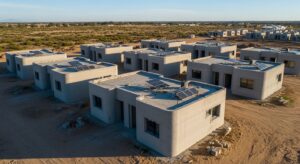
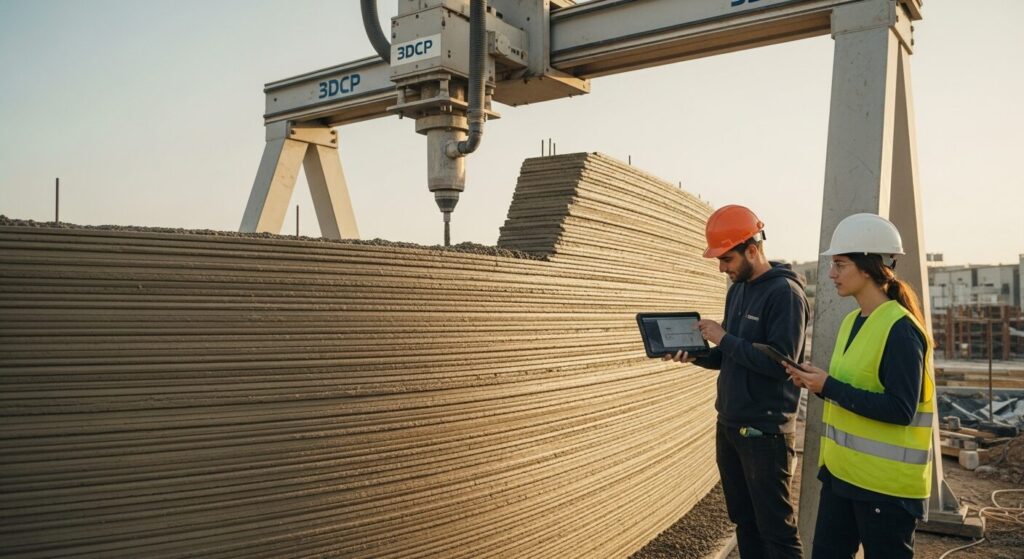
A 3DCP operator doesn’t do what a traditional laborer does. They read layer data, monitor mix flow, and run a machine that builds walls to millimeter precision from a BIM plan. The physical effort is still real. This is still field work. But alongside it sits an engineering responsibility that didn’t exist in classical construction. Constructions-3D, manufacturer of the MaxiPrinter, offers an 8-week training program that qualifies three roles in one: machine operator, team leader, and digital builder. MudBots University does it in 4 to 5 weeks. The US Department of Housing and Urban Development built a full 3DCP curriculum and is integrating it into community colleges across the US.
And when you look at salaries, the picture tells the same story. Construction workers who operate technology earn on average 24% more than counterparts who don’t.1 Technology integration specialists on construction sites reach $72,000 to $98,000 a year.2 In the data center sector, where robotics is already widespread, construction workers are reaching six-figure salaries.3 An industry that offers technology-level pay starts attracting people who were considering technology.
At Laycon, when we think about the team we’re building, we’re not looking for people who can mix concrete by hand. We’re looking for people who combine technical thinking with field presence. Who understand systems. Who have patience for precision and are ready to learn a machine the way you learn any new tool. That’s not a profile classical construction even knew how to recruit for. It didn’t have a tool that needed people like that.
Now it does.
This generation is already out there. They grew up with technology, maybe considered engineering or a technical trade. Construction just didn’t look like a place that was waiting for them. Construction 4.0 changes that.
Construction doesn’t need to compete with tech. It needs to become the kind of industry that people from tech choose to enter.
I made that move. There are others who will.
Sources:
1 The Birm Group, Construction Salary Trends 2025
2 Construction Technology Integration, Salary.com 2025
3 Fortune, “Construction workers are earning six-figure salaries in the data center boom”, 2025
Thinking about how 3DCP fits into your next project? Let’s talk.