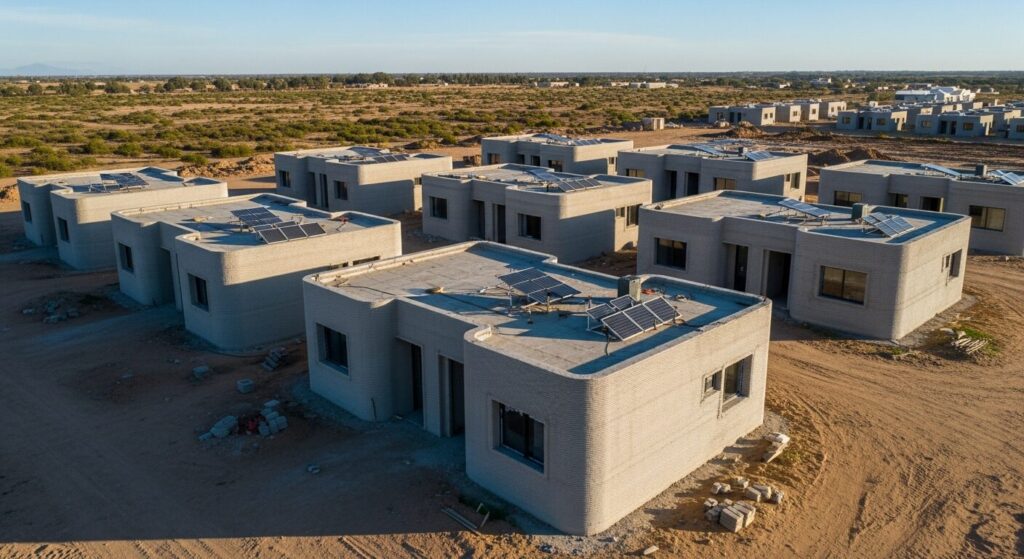
Land is available in Israel’s periphery. Everyone knows this.
But anyone who has tried to develop there reaches the same conclusion: cheaper land doesn’t solve the problem. Because the problem was never the land. The problem is the cost of construction itself.
A developer evaluating a housing project in a peripheral region always arrives at the same point: the price achievable in a remote location doesn’t justify the cost of building there. The margins don’t work. This is not a matter of willingness — it’s arithmetic. High labor costs, dependence on workers who don’t always show up, long build times that compound financing costs — these factors make peripheral projects less attractive than central ones, even when land is significantly cheaper. The result: peripheral regions don’t develop at the pace local authorities want. Not because demand is absent. Because the economics aren’t there.
The only thing that changes this equation is reducing the cost of construction itself.
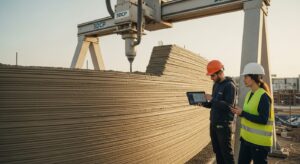
Last week, Forbes covered a shift that has been happening quietly: cities around the world are moving from 3DCP experiments to real municipal investment in the technology. Dubai set a mandate — 25% of all new government buildings must use concrete 3D printing by 2030. In Texas, three printed homes have already been delivered to buyers. ICON, Oldcastle APG, and New Standard Homes did not demonstrate technology — they sold homes that families live in today.
The question guiding those projects was not “does the technology work?” — it was “do the numbers work?”
The numbers that change the equation are specific. Concrete 3D printing reduces construction costs by more than 33%, shortens structural build time by 70% to 80%, and reduces framework labor dependency by 87.5%. For a peripheral development project, this means one clear thing: a project that didn’t pencil out under traditional construction can become profitable. The available land that sat idle because the math didn’t work — starts working. For a local authority, the same construction budget produces more housing units, and the same timeline delivers results faster.
The technology itself exists and is globally proven. After dozens of projects across 14 countries, there is no question whether it works. [See also: 3DCP in construction — what the method file process looks like](INTERNAL LINK: method file article). In Israel, the remaining question is regulatory only.
To build using a new method in Israel, an approved method file is required — a document that proves to the regulator exactly how the structure was designed, tested, and what quality assurance system stands behind it. Without a method file, there is no building permit. Preparing a method file involves selecting a qualified structural engineer, a materials laboratory to validate the local concrete mix, and a QA system that documents every stage of the process. This work takes 12 to 18 months. It cannot be compressed.
Whoever starts now, in 2026, will have an approved method in hand when procurement opens. Whoever waits will finance another two years of standing still.
The dynamic is clear. Demand for peripheral housing exists. Land is available. The technology is proven. The only remaining barrier is building the local regulatory foundation. A local authority that partners in this process now gains the ability to build faster, at lower cost, with significantly less dependence on construction labor. An investor entering a 3DCP project at the current stage enters a market before it opens to everyone.
Want to learn more? Let’s talk. laycon.io
—