New market reports from April 2026 confirm it: the 3D concrete printing (3DCP) market has crossed $1.49 billion. By 2031, analysts project $17 billion, growing at a CAGR above 63%.1 The numbers are real. But they do not answer the question every contractor, developer, and investor actually wants answered: is the technology ready for real projects, with real clients, real permits, and auditable quality control?
What the Market Reports Actually Count
When a report announces $1.49 billion, it counts everything: equipment sales, government-funded research, non-commercial pilots, consulting contracts, and software development. Completed buildings with paying clients, approved permits, and a QA process that a bank or insurer can verify? Those represent a much smaller share of the headline number.
That is not an argument against the market. It is growing at a pace the construction industry has not seen in decades. But market size tells you where the money is going. Not where the buildings are.
What Operational Readiness Actually Looks Like
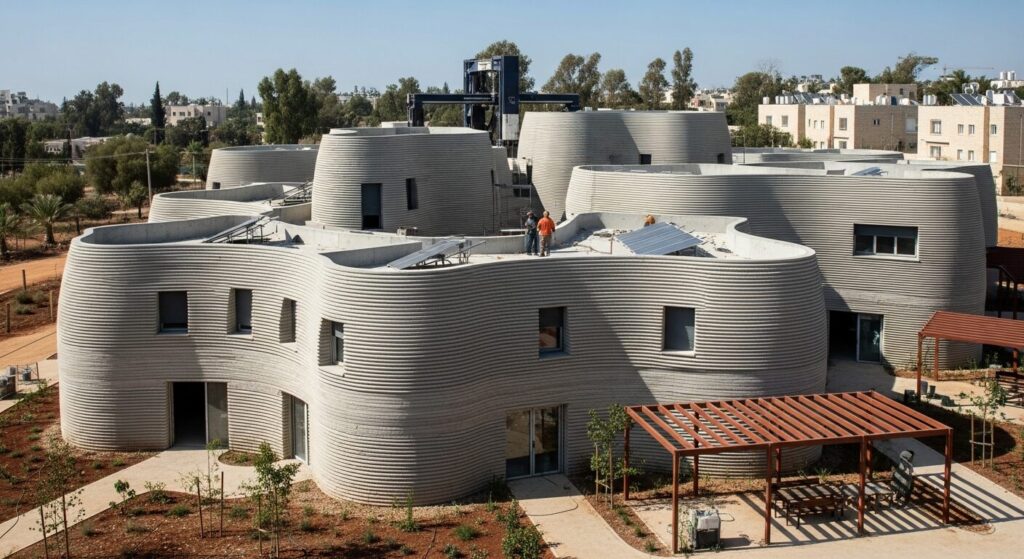
The project that best illustrates the gap between hype and execution is Zuri Gardens in Texas: 80 printed homes, 100% affordable housing, delivered on commercial timelines and budgets.2 The team behind it described the core advantage simply: “The big advantage is you can have economies of scale: high-quality homes that are energy efficient and low carbon.”
This was not a pilot. It was built on infrastructure that took years to develop:
- A validated concrete mix for local climate and local aggregates (not a formula tested in a factory somewhere else)
- A structural engineer licensed on local building code who signed off on the engineering solution
- An auditable QA/QC process that banks, insurers, and regulators can verify after the fact
- A regulatory pathway that someone built from scratch, document by document
Without each of these components, the printer cannot operate on a real project. Not with clients, banks, and inspectors involved.
Most companies in this space have one or two of these. Very few have all four. That gap is where most projects stall.
The Regulatory Barrier Most Reports Ignore
In most markets, no standard approval track exists yet for 3DCP construction. That means the regulatory pathway must be built company by company, project by project. This is the real barrier to scale, and it is almost never captured in market size numbers.
A headline that says “$1.49 billion” does not distinguish between a company that completed one permitted building and one that has sold equipment to a government pilot that may never break ground. Both count.
The companies that will capture meaningful market share over the next five years are not the ones with the most impressive demo reels. They are the ones that finish the regulatory groundwork first and can repeat it.
The Right Question to Ask
The $1.49 billion figure matters because it confirms the technology works at scale globally. The real question for any investor, developer, or contractor evaluating a 3DCP opportunity is not “does the technology work?”
It is: “Does this company have a validated material mix for local conditions, a licensed structural engineer on local code, a verifiable QA/QC process, and a completed regulatory pathway?”
That is what separates a demo from a building.
That is what we are building.
Want to learn more? Let’s talk.
1 Mordor Intelligence, 3D Concrete Printing Market Report, April 2026 Global market: $1.49B in 2026, projected $17.27B by 2031 (CAGR 63.23%).
2 The Architect’s Newspaper, Zuri Gardens: 80 3D-Printed Affordable Homes in Texas, February 2026