In the world of construction, time has always been the most expensive variable.
For decades, the industry accepted a “standard” pace for residential projects, but new data is proving that the old benchmarks are no longer relevant.
By shifting from manual labor to automated industrial production, the delivery of a structural shell is undergoing a radical transformation.
The Shift to Rapid Structural Execution
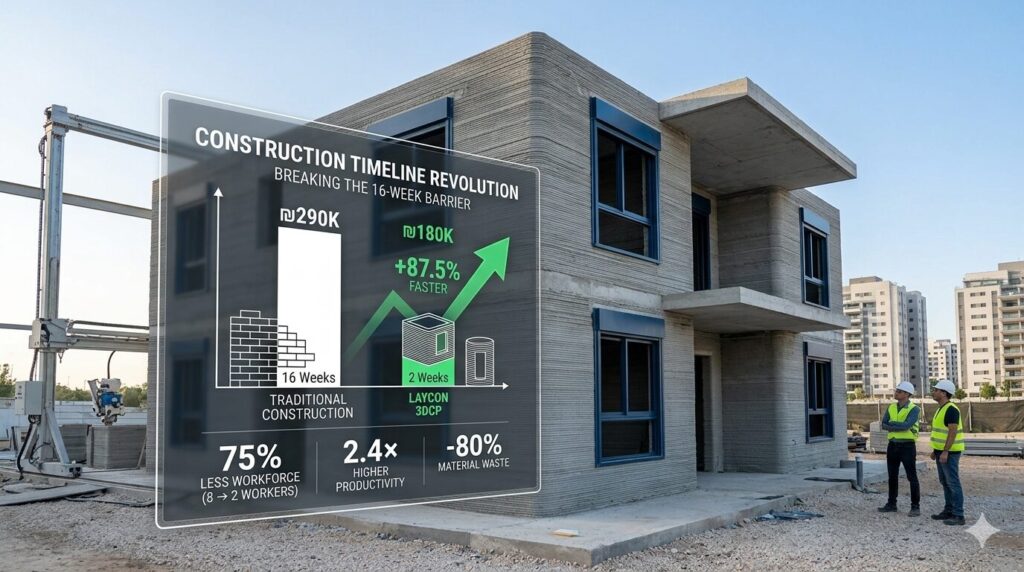
The most striking shift is in the timeline of the structural shell. Traditional masonry and casting methods typically require a window of 16 weeks. However, practically implemented 3D Concrete Printing (3DCP) benchmarks show this same phase is now completed in just 2 weeks.
This 87.5% increase in speed isn’t just a technical achievement—it’s a massive financial advantage for homeowners and developers, allowing for significantly earlier occupancy and a faster transition to finishing works.
Decoupling from the Labor Crisis
As the shortage of skilled labor continues to disrupt project schedules, automation offers a path toward “Labor Decoupling.” The efficiency gap between traditional sites and automated ones is now measurable:
Workforce Reduction: A traditional structural site requires a crew of approximately 8 workers, whereas 3DCP operates with only 2 specialized operators.
- Productivity Surge: Despite the smaller crew, the structural productivity per worker is 2.4× higher than manual methods.
By reducing dependency on large construction crews, projects gain a level of predictability and control that was previously impossible in manual construction.
Economics of Precision: Lower Costs, Zero Waste
The move toward industrialized printing is also rewriting the budget sheet. For a standard 100 sqm structure, the data reveals a clear economic edge:
| Performance Metric | Traditional Method | Laycon 3DCP | The Impact |
| Structural Cost (100 sqm) | ₪290,000
| ₪180,000
|
38% Saving
|
| Construction Waste | Baseline
| -80%
|
Zero-Waste Goal
|
The 38% reduction in structural costs is driven by the precision of the printing process, which ensures that concrete is only placed where it is structurally necessary. This approach practically eliminates the heavy material waste associated with traditional casting, which is often reduced by up to 80%.
The Bottom Line
The integration of 3DCP technology is no longer a futuristic concept, it is a proven methodology for delivering high-performance structures faster, cheaper, and with greater environmental responsibility. For those looking to build in today’s volatile market, these benchmarks represent the new standard of engineering certainty.