Executive Summary
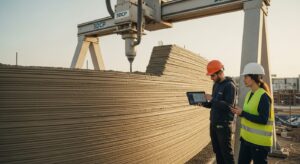
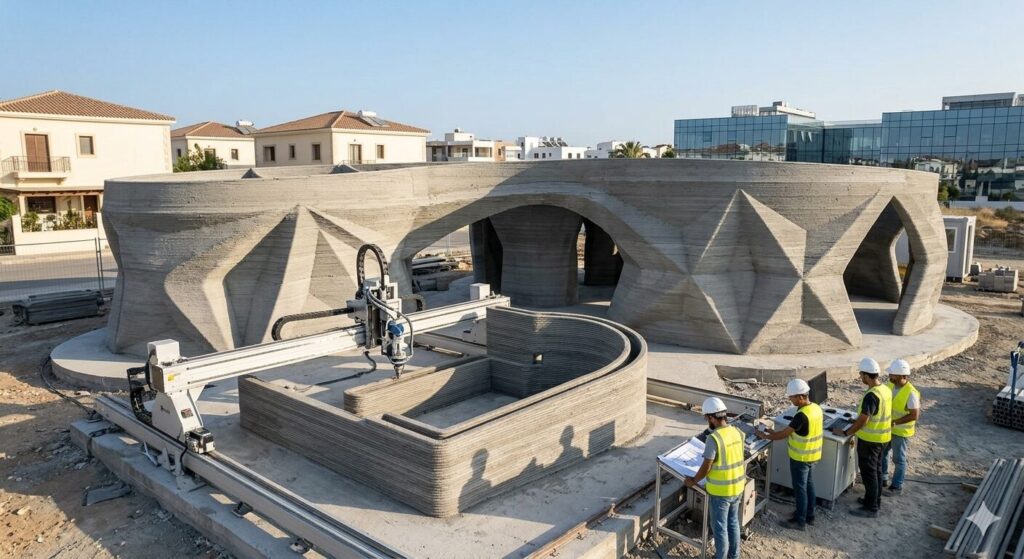
3D Concrete Printing (3DCP) is transforming construction from a manual, labor-intensive craft into a precise industrial process.
By leveraging global industry benchmarks, this report demonstrates how 3DCP solves the critical challenges of modern building:
- Reducing labor dependency.
- Cutting structural costs by up to 38%.
- Accelerating completion by 87%.
Private Residential: Solving the Housing Crisis for Individual Homeowners
For the individual landowner, traditional construction has become a journey of uncertainty: rising labor costs, unpredictable timelines, and a critical shortage of skilled workers.
3DCP technology directly addresses these pain points by replacing months of manual wall-laying with days of automated production.
The Global Standard
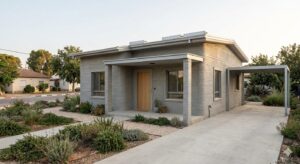
International implementations for private villas have proven that the structural shell of a family home can be completed in under 72 hours of active printing.
By moving to an automated workflow, homeowners gain:
Timeline Certainty: No more delays due to subcontractor availability.
Cost Efficiency: Significant reduction in onsite overhead and material waste.
Design Freedom: Creating organic, curved, or customized walls without the prohibitive cost of custom formwork.
Public & Municipal Infrastructure: Rapid Community Development
Municipalities and local councils face the urgent need for rapid, high-quality infrastructure. Whether it’s a new classroom to meet population growth or a municipal service building, 3DCP allows public entities to deliver more with less.
Proven Applications in Public Sectors
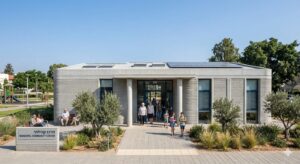
Case studies from leading global projects demonstrate that 3DCP is the ideal solution for:
Schools & Classrooms: Rapidly deployable educational spaces that meet strict safety standards.
Community & Municipal Buildings: Durable, functional structures built with localized materials.
Storage & Agricultural Facilities: High-strength warehouses and partitions that withstand extreme conditions.
These public projects validate that 3DCP is not a “future” technology, it is a current, reliable method for delivering essential social infrastructure.
Comparative Analysis: 3DCP vs. Traditional Construction
To understand why global markets are pivoting to 3DCP, we must look at the data.
The following table represents Industry Benchmarks derived from successful large-scale implementations worldwide:
| Metric | Traditional Masonry / Casting | 3DCP Industry Benchmark | Laycon Advantage |
| Structural Shell Timeline | 4 – 8 Weeks | 3 – 5 Days | ~87% Faster |
| On-Site Labor Required | 8 – 12 Workers | 2 – 3 Operators | Labor Decoupling |
| Material Waste | 20% – 30% | < 2% | Zero-Waste Goal |
| Design Flexibility | Limited / High Cost | Unlimited Geometric Freedom | Architectural Edge |
| Compressive Strength | 20 – 30 MPa (Standard) | 40 – 70 MPa (High-Perf) | Superior Durability |
Engineering Integrity: Beyond the Aesthetics
The credibility of 3DCP lies in its engineering.
Global implementations for retaining walls, engineering partitions, and structural infrastructure have undergone rigorous testing to meet ASTM International and ISO/ASTM 52900 standards.
By adopting topology optimization, the mathematical approach of placing material only where it is structurally necessary, these projects have proven that we can use 40% less concrete while achieving higher load-bearing capacities than traditional cast walls.
Conclusion
The success of 3DCP is no longer a question of “if,” but “how fast.”
By integrating these globally proven methodologies with local building conditions and standards, Laycon provides a reliable, industrialized path for private homeowners and public councils alike. For more information, visit our Laycon Applications Page.