Dubai set a target: by 2030, 25% of all construction in the city will be 3D-printed. Saudi Arabia is pouring hundreds of billions into NEOM and entire neighborhoods built with methods that didn’t exist a decade ago. The Middle East is moving fast.
So is Israel. Quietly, and all at once.
In the past year, three forces converged at the same time: regulators updated the rules, the market consolidated its tools, and the technology reached the field. This isn’t a single event. It’s a visible trend. And when government, contractors, startups, cities, and developers all start moving in the same direction simultaneously, that’s not a trend anymore. That’s structural change.
Israel’s planning authority is building a performance-based regulatory track, the first update in 50 years, that will allow new construction methods to be approved through proof, not by waiting for the law to update clause by clause. The concept is simple: demonstrate it works, get approval. This approach is usually found in medicine and biotech. Now it’s coming to construction.
At the same time, the Investment Authority and Ministry of Housing allocated 12 million shekels not as a general industry grant, but specifically for methods that measurably reduce manual labor dependency. That’s a clear signal: the government isn’t just talking about the labor shortage. It’s funding solutions. And the Ministry of Housing is preparing a new type of tender where bidders compete not only on price, but on the level of construction innovation they bring to the table. When the government changes the rules of procurement, the industry follows.
But regulation alone doesn’t tell the full story. What’s more striking is that the private ecosystem was already there, well before the government made a single decision.
ConTech Israel, the innovation hub for construction and real estate technology, manages a community of over 300 startups with 800% growth in five years (source: Startup Nation Central). That’s not a marketing figure. It reflects real demand: contractors, engineers, and developers looking for solutions that had no name a year ago. The ConTech accelerator brings four to six startups per year into deep industry integration.
In June 2026, Israel’s construction sector gathers for the second Construction Innovation and Industrialization Conference, in Natanya. The second. That means there’s already a tradition. Organized by the Israeli Building Center, the General Contractors Association of Israel, ConTech, and the Industry Development Fund. Topics on stage: industrialized construction, modularity, robotics, BIM, and field data management. When the General Contractors Association stands behind a conference like this alongside ConTech, it isn’t another tech seminar. It’s the industry saying: we’re serious.
The major players aren’t waiting for conferences either. Tidhar, one of Israel’s largest real estate groups, established an independent modular construction arm about two years ago. It has already delivered approximately 700 units to its own projects. A full modular factory in Sderot launched in partnership with UK-based Elements Europe. The “Etrog” project in Ashdod, 75 public housing units produced entirely at a factory in Yavne and assembled on-site using a plug-and-play method, is the first of its kind in Israel. Tidhar has also invested over 100 million shekels in 25 ConTech and PropTech startups, and on active sites they’re already working with Buildots for deviation detection, GreenVibe for concrete optimization, and WINT for water damage prevention. Every technology is tested in a real project, not a demo.
Ashdod is consolidating as a center of gravity. That’s where Tidhar’s Etrog project is, and that’s also where Dakla Abutbul, chair of the Small Business Association of Israel and founder of the Hub-Tech initiative, is leading a construction technology innovation center that develops solutions on the ground, together with contractors, not just for them. Five domains: flooring, finishing work, work at height, outdoor work, and remote operation of heavy equipment. The approach there is different from a standard incubator. Hub-Tech doesn’t present existing technologies. It builds new ones alongside the field.
In Tel Aviv-Yafo, City Zone operates as an open innovation lab recognized by the Israel Innovation Authority as an official National Beta Site. Startups selected to work there get access to real city data, field testing in an urban environment, and direct connection to decision-makers. In the western Negev, the Mitbachon innovation center operates across five domains, construction being one of them, under pressure that wasn’t there before: rebuilding the south after October 7th requires building faster, with fewer hands. Tkouma Administration, which recently moved its offices to Sderot precisely because of this, represents that demand. That’s a real engine for innovation, not just a narrative.
What This Means for the Industry
What’s happening here is different from what Israel usually does: it isn’t one company finding a solution while everyone else waits to see if it’s real. This time, regulation, capital, community, and major players are moving together. A trend that comes from one direction stops. A trend that comes from every direction at once creates structural change.
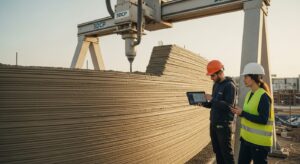
Laycon is inside this movement. We’re building the regulatory path for 3D concrete printing in Israel, through Phase I of NBRI at the Technion. This is exactly the track the planning authority is describing: performance-based, proof-based. We’re building the proof from our side.
If you’re a contractor, engineer, developer, or investor who wants to be part of this wave, not as a spectator but as a player, now is the time to talk. The market isn’t waiting. Neither are we.