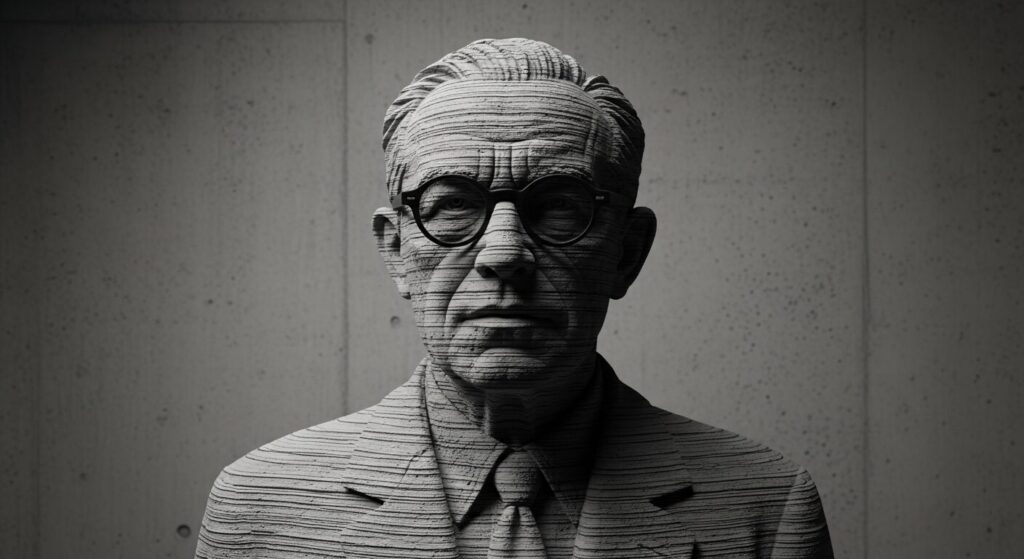
In the 1950s, Le Corbusier did something that looked like provocation: he left the concrete exposed. No coating, no plaster, no cover. He called it béton brut (raw concrete). The building makes no apology for what it is made of.
From that came an entire movement. Brutalism built decades of architecture on one principle: concrete hides nothing. The material itself is the finish.
Then came the cladding. Decades of plastering, painting, covering. “Exposed concrete” became an apologetic phrase. A sign of an unfinished building.
The return was slow. First restaurants that stripped plaster and discovered concrete underneath. Hotels that built bare concrete walls with pride. Apartments that listed exposed concrete ceilings as a selling point: what was once a deficiency became a feature. Then came the tiles. Millions of square metres of “concrete-look” tile produced each year, which says something about how legitimate this aesthetic had become.
But the current chapter in concrete’s development is different. Not just exposing concrete. Printing it. Giving it texture, form, and direction that did not exist before. Concrete no longer apologises and no longer hides. It is no longer just raw. It is the product of intention.
In 2021, Zaha Hadid Architects built a bridge with no mortar, rebar, or adhesive.
Fifty-three interlocking concrete blocks, each printed with its layers oriented perpendicular to the compression forces it would carry. The blocks hold each other in place through structural geometry alone. They named it Striatus and installed it at the Venice Architecture Biennale.
What made Striatus possible was not the strength of the concrete. It was the direction of printing. Each layer was deposited perpendicular to the compression forces it would carry, so the concrete works exactly as it is meant to: in compression. The lines visible on the surface of the bridge are not texture. They are the structure itself, made visible.

The Principle Behind All of It
What sets 3D concrete printing apart as a design medium is one principle: complex geometry costs exactly the same as simple geometry. Formwork has a price. Shape does not. When that changes, design decisions change with it.
This explains why architects and designers at the top of the field are working with 3DCP not as a shortcut, but as a formal language.
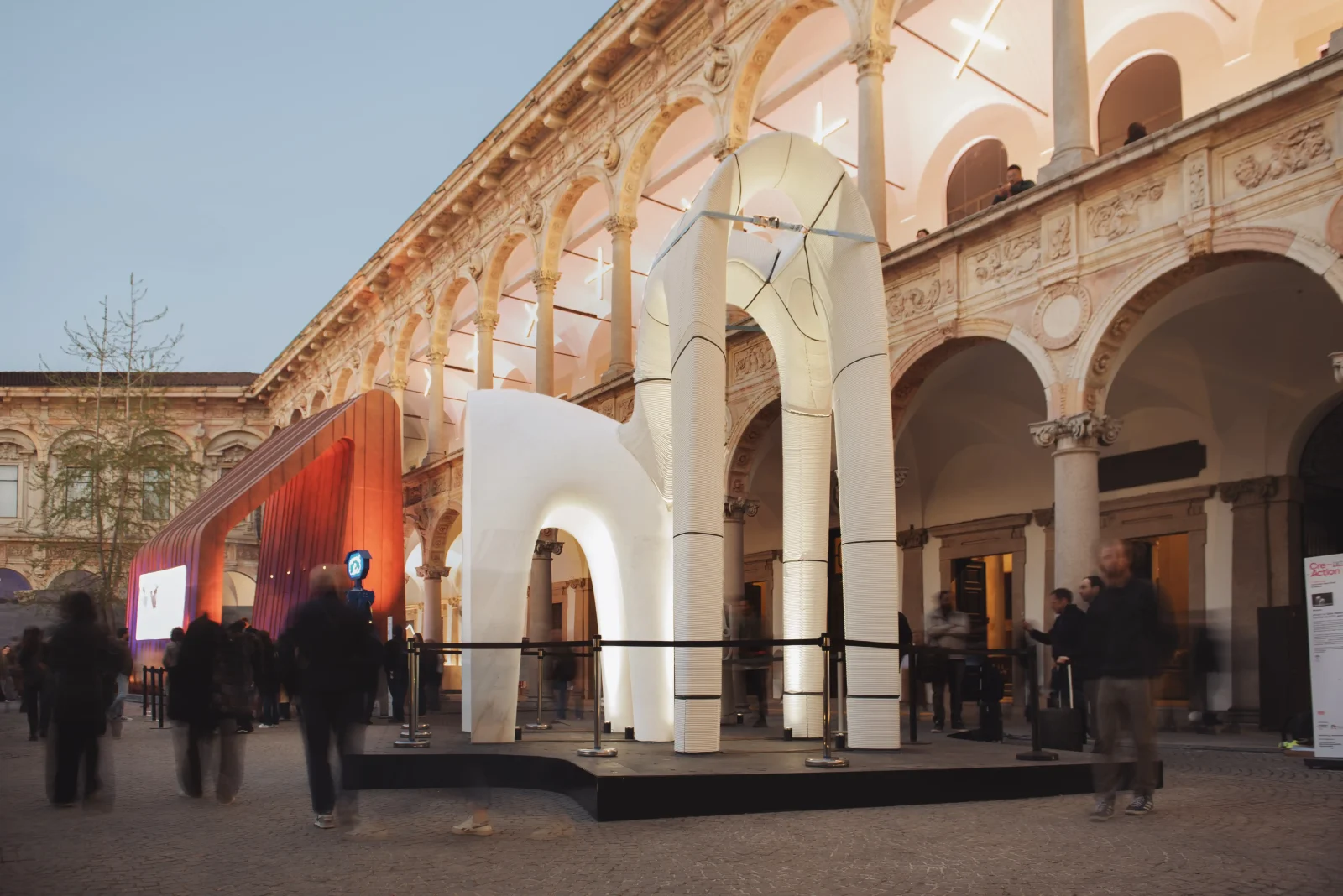
At Milan Design Week 2025, ZHA and Vertico installed Aevum: three arches in a row, one carved from white Bianco Merano granite in the traditional way, two printed in concrete incorporating marble dust recovered from quarry waste. The tallest arch reaches seven meters. Twenty-one individually unique interlocking elements, freestanding, no support structure. A firm with nearly five decades of formal ambition chose to print.
In Austin, Texas, BIG designed the Cosmic Pavilion for the Long Center for the Performing Arts: leaning curved walls, stacked circles, a surface texture that reads geological. Fourteen printing days. One thousand three hundred people attended performances on opening weekend. BIG and ICON are now building El Cosmico, a full resort in Marfa, Texas, with guest accommodation shaped like formations emerging from the Chihuahuan Desert floor, printed from local soil and aggregates.

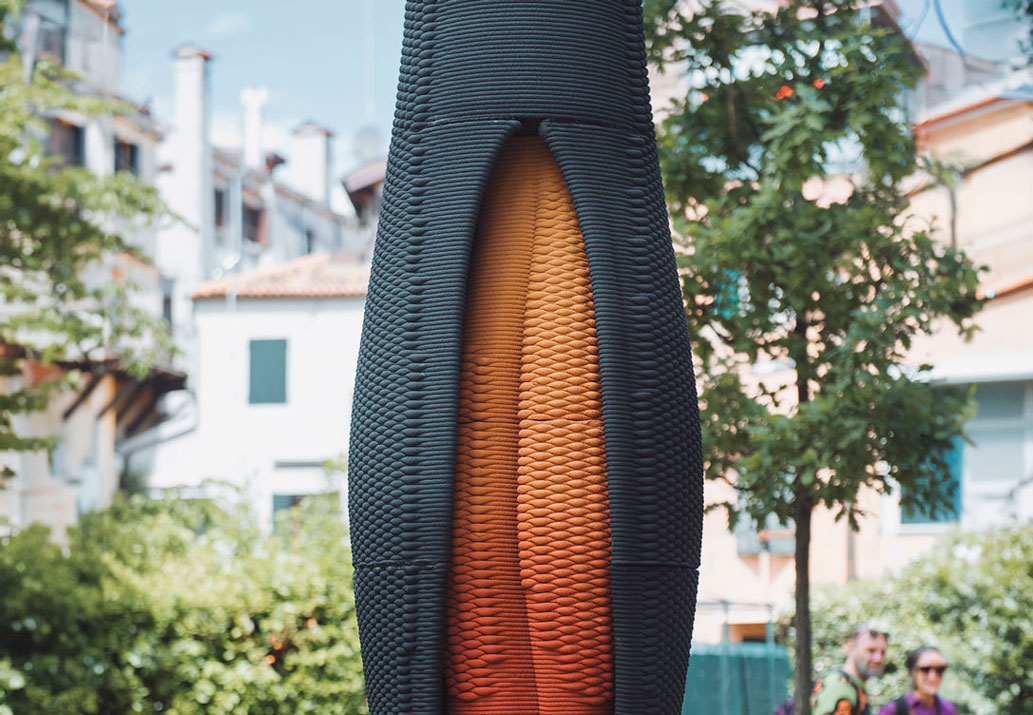
At the Venice Architecture Biennale 2025, TU Eindhoven and Vertico presented Duality: a modular column built from stacked cylindrical segments, each a printed tube. The outer wall of each segment is grey concrete with rhythmic openings. Through those openings, the inner core is visible: its color transitions from orange at the base to deep red at the top. The gradient is not painted. It is embedded in the material during printing, injected at the nozzle in real time. A column in the Greco-Roman tradition, produced by a machine.
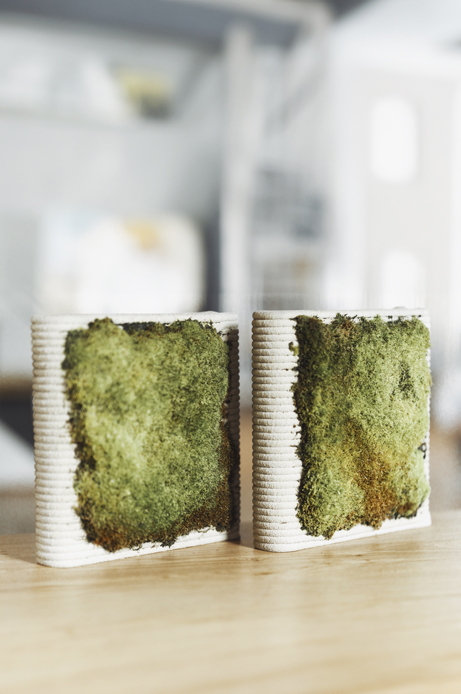
Vertico is developing a bio-receptive facade panel whose surface texture is engineered to retain moisture and anchor moss. The geometry of the print pattern creates micro-recesses that trap water and spores. As moss colonizes it over seasons, the facade becomes a living surface. The design decision is made at the printer, not in the landscaping budget.
The most unexpected project is not on land at all. In 2025, twenty-two life-sized car sculptures were placed on the seabed off Miami Beach. A ninety-foot star-shaped structure, built from fifty-six printed modules, was installed alongside them. The concrete chosen was formulated to promote coral growth. Within years, the structures will become an active reef. Not an art project that became a reef. A project designed as both simultaneously.

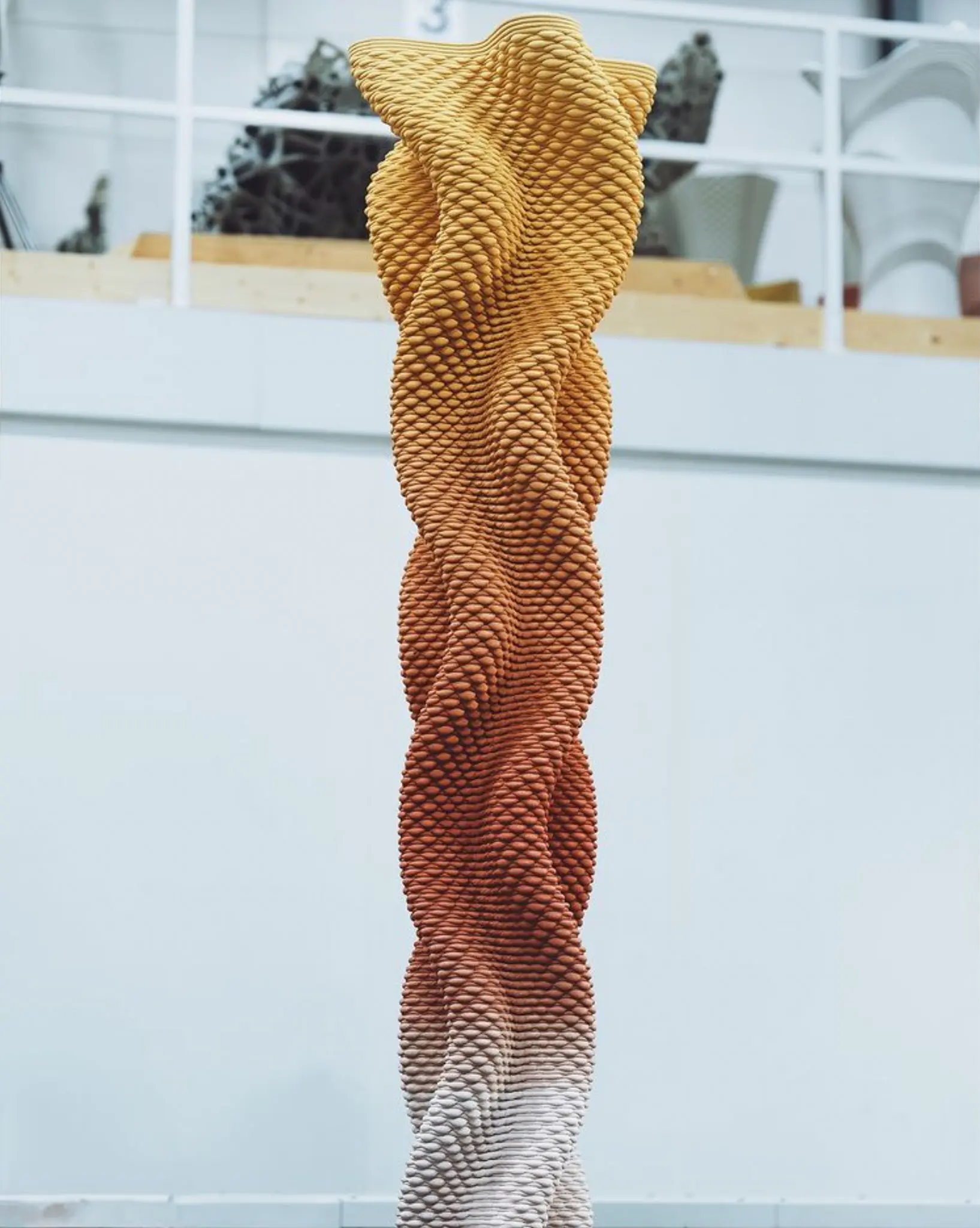
Philipp Aduatz in Vienna printed a furniture collection where the color gradient runs through the concrete itself, injected live into the print head as each piece is produced. No two pieces are identical. The layer lines of the printing process are the final surface texture.
What the Lines Say
There is something engineers try to solve and architects are beginning to keep on purpose.
In 3DCP, every layer leaves a mark. A horizontal line, a defined thickness, repeating across the entire surface. Engineering literature calls this the “staircase effect” and searches for ways to reduce it. A growing number of architects call it texture, and ask what can be done with it.
HANNAH Studio, an experimental architecture office in New York, built an entire cabin from nine 3D-printed concrete segments: floor, fireplace, fixtures. The horizontal layer lines of the printing process are the final finish. When a few milliliters of concrete dripped during the printing of the fireplace and left an unplanned mark on the wall, they kept it. They described it as “a moment of the material’s own volition.”

At Striatus, ZHA took the logic further. The bridge was printed on six axes, not just horizontal passes. The direction of printing for each layer was determined by the direction of compression it would carry. The lines visible on the surface of the bridge are a map of structural forces. What reads as aesthetic is engineering, made visible.
Vertico worked the opposite end of the spectrum. They developed a system that injects pigment directly into the concrete during printing, layer by layer, under precise control. Columns with color transitions running from bottom to top, orange shifting into deep red. The color is not painted. It is part of the material. And Vertico also developed the inverse: robotic milling of the concrete in its green state, before curing, which erases all trace of the printing layers and leaves surfaces that are either perfectly smooth or precisely grooved to the millimeter.
At Desert X in the Coachella Valley in 2025, architect Ronald Rael printed real adobe: earth, water, and organic binder. Corrugated walls programmed to mimic the texture of palm tree trunks in the surrounding landscape. He called it “ancestral intelligence plus artificial intelligence.” The installation stood near the ruins of centuries-old indigenous earthen architecture. His argument was explicit: concrete printing does not break from tradition. It continues it.
This parallel is not incidental. Rammed earth works on the same logic: a layer of moist earth is compacted, leaving a visible mark. The next course is compacted above it. The structure tells its own history on its surface. 3DCP does exactly the same thing, with concrete, at machine speed.

Across all of these projects, the architects and designers found the same thing. Concrete printing is not a faster way to do what they were already doing. It is a different set of possibilities. Forms that were economically impossible are now standard. Materials that had no construction application are now structural. Geometry that required expensive single-use formwork is now printed in the same time as a simple box.
In Israel, Laycon is working to open the regulatory path for this technology. That work starts with construction. But the design language it unlocks, as these projects show, extends much further than any single building type.
Want to learn more about what 3DCP can do? Read our introduction to the technology
Want to explore what this means for your work? Let’s talk.