Executive Summary
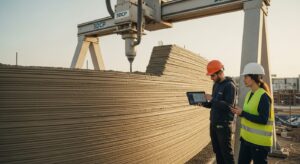
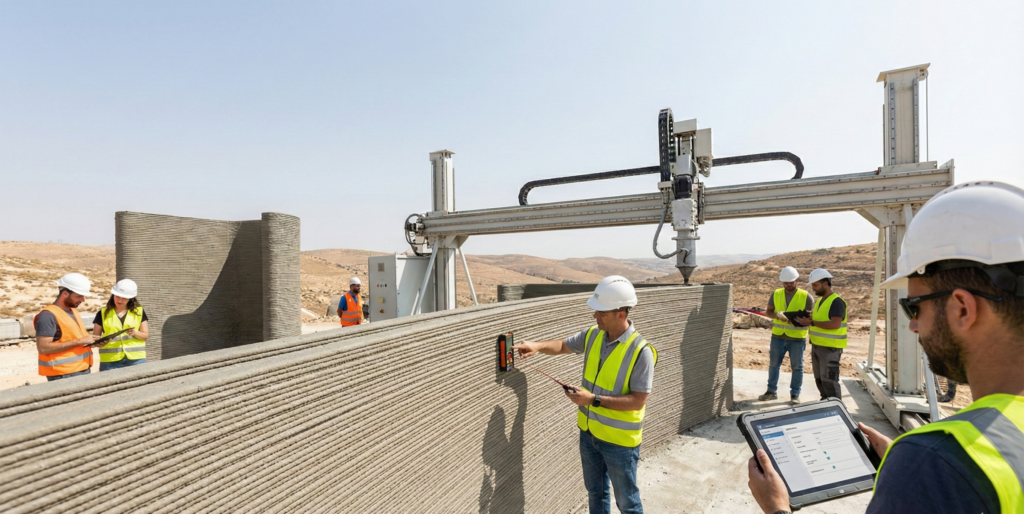
Laycon’s 3DCP framework optimizes structural completion by 87% through advanced material rheology and topology optimization.
By achieving compressive strengths of 40–70 MPa and reducing material waste by 40%, our additive construction methodology meets rigorous international building codes while significantly lowering the carbon footprint.
This technical approach ensures that the future of construction is not just faster, but structurally superior and environmentally sustainable.
Introduction
As the global construction industry shifts toward automation, 3D Concrete Printing (3DCP) has emerged as the definitive solution for high-efficiency, low-waste additive construction.
At Laycon, our methodology transcends simple extrusion; it is a sophisticated integration of material science, robotic precision, and parametric design.
This technical overview explores the core pillars that define the structural and operational success of our 3DCP framework.
Material Science and Rheology: The Printability Window
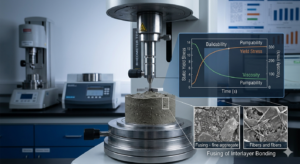
The success of any 3DCP project depends on the rheological properties of the cementitious mixture.
To ensure consistency, we adhere to the standards set by the RILEM Technical Committee on Digital Fabrication. Our proprietary mix is engineered to perform across four critical stages:
Pumpability: Maintaining low dynamic yield stress to ensure a consistent flow from the mixer to the nozzle without segregation.
Extrudability: High shape retention upon exit, ensuring the “bead” maintains its dimensional integrity.
Buildability: A rapid evolution of static yield stress, allowing the lower layers to support the weight of subsequent layers without plastic collapse.
Interlayer Bonding: Precise management of the “open time” to facilitate chemical fusion between layers, eliminating the risk of cold joints.
Structural Integrity and Performance Metrics
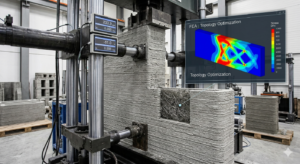
Laycon’s printed elements are designed to meet and exceed ASTM International Additive Manufacturing Standards. By optimizing the water-to-cement ratio and incorporating specialized admixtures, our printed mortar achieves a compressive strength ranging from 40–70 MPa.
Beyond material strength, we utilize Topology Optimization. This parametric design approach allows us to place material only where structural stress requires it, often reducing total material volume by up to 40% without compromising safety.
For high-load requirements, our system allows for the seamless integration of micro-fiber reinforcement and dedicated cavities for post-tensioned steel reinforcement, as discussed in American Concrete Institute (ACI) Committee 564 guidelines.
Operational Efficiency and Sustainability
The transition to 3DCP represents a fundamental shift in project economics. Our data indicates an 87% increase in structural completion speed compared to traditional masonry, alongside a 38% reduction in overall construction costs.
By eliminating timber formwork and minimizing onsite labor, we significantly reduce the carbon footprint of every project. This “zero-waste” approach aligns with global “Green Building” and LEED standards, making it the preferred choice for forward-thinking developers.
Conclusion
3DCP is not merely a trend; it is a specialized engineering discipline. Through continuous R&D in material rheology and robotic path optimization, Laycon is setting the standard for the next generation of resilient, sustainable, and high-performance architecture.
For technical inquiries regarding specific project implementations or material data sheets, visit our Laycon Product Page.